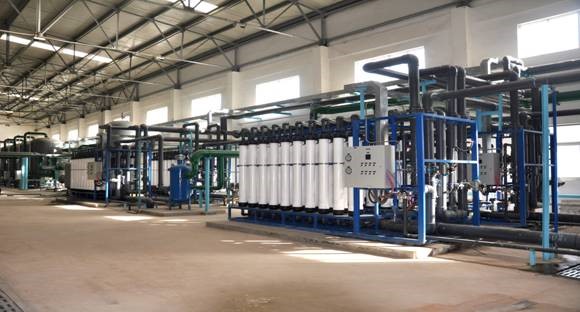
Water Treatment System
The quality of water in a thermal system is one of the important factors affecting the safe and economic operation of thermal equipment (boilers, steam turbines, etc.) in power plants. Natural water that has not been purified contains many impurities. If it enters the water vapor circulation system directly, it will cause various hazards to the thermal equipment. In order to ensure good water quality in the thermal system, it is necessary to use a water treatment process to properly purify the water and strictly supervise the quality of the soda.
The thermal system and chemical water treatment equipment supply by chindo power plant. ensure that all parts of the thermal system have good water vapor quality to prevent scaling, corrosion and salt accumulation of thermal equipment, and ensure safe and economic operation of the system.
The water treatment mainly includes the following contents:
1. Purify raw water and prepare the quality and quantity of make-up water for the thermal system. Including coagulation, clarification, sedimentation, filtration, etc., used to remove suspended solids and colloidal impurities in natural water; softening treatment to remove hardness components such as calcium and magnesium ions dissolved in water; desalting treatment to remove all dissolved salts in water . The treatment of make-up water is usually called treatment outside the furnace.
2. Deoxidation and dosing treatment of the feed water to remove dissolved gases in the water to prevent dissolved oxygen corrosion.
3, the drum boiler boiler dosing treatment and sewage, so that the water impurities do not form scale, these work is called furnace water treatment.
4. In the thermal power plant, the chemical water treatment of the power plant for the purification of the production return water by degreasing and iron removal.
The chemical water treatment of power plants is mainly for the following hazards caused by poor soda quality in thermal power plants:
1. Thermal equipment scaling:
Poor water quality entering the boiler or other heat exchangers. After running for a period of time, on the heated surface in contact with water, some solid deposits, ie scales, are formed. These solid deposits are called scales. Because the thermal conductivity of scale is much lower than that of metal, and scale is easily generated in boiler tubes with high heat load, scaling is very harmful to boilers and heat exchangers. The scale will make the temperature of the metal pipe wall in the fouling part too high, causing the strength of the metal to drop. Under the action of the pressure inside the pipe, local deformation of the pipe, bulging, and even serious accidents such as squibs may occur; and the fuel consumption is greatly increased. To reduce the economics of power plants, chemical water treatment equipment must be used for water treatment.
2. Corrosion of thermal equipment:
Water supply pipes, heaters, boiler economizers, water walls, superheaters and steam turbine condensers of thermal power plants are subject to corrosion due to poor water quality. Not only shortens the service life of the equipment, but also aggravates the scaling process on the heated surface of the high heat load, and the formed scale accelerates the corrosion of the boiler pipeline. A vicious circle will quickly lead to a tube burst accident. The corrosion products of metals are brought to the steam turbine for deposition, which also seriously affects the safe and economic operation of the turbine. The power plant chemical water treatment system is used for water treatment to avoid corrosion of thermal equipment.
3. Salt accumulation of superheater and steam turbine
Poor water quality without good water treatment makes the boiler unable to produce high-purity steam, causing steam pollution. Impurities with steam are deposited in various parts of the steam, such as superheaters and steam turbines. This phenomenon is called salt accumulation. The accumulation of salt in the superheater tube will introduce the overheating or even bursting of the metal pipe wall; the salt accumulation in the steam turbine will greatly reduce the output and efficiency of the steam turbine, especially the high temperature, high pressure and large capacity steam turbine, and the cross section of the high pressure part of the steam circulation is small. A small amount of salt will also greatly increase the resistance of steam circulation, so that the output of the turbine is reduced. And the thrust bearing load is increased, the baffle is bent, causing turbine vibration or even accidental shutdown.
The water treatment of thermal power plants is to ensure that all parts of the thermal system have good water vapor quality to prevent scaling, corrosion and salt accumulation of thermal equipment. Chemical water treatment in power plants is of great significance to ensure the safe and economic operation of power plants.