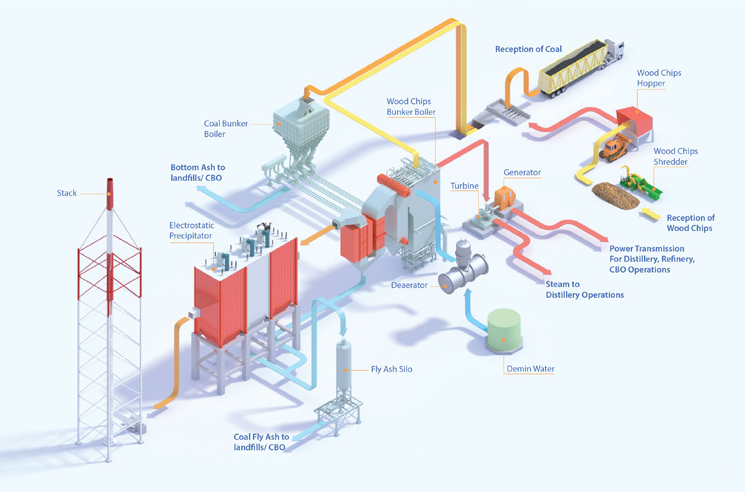
Steam boiler plant
Choosing one of the different types of boilers for your facility can be confusing. Its important to understand each of the different types of systems as well as their pros and cons. Fortunately, you dont have to go at it alone now.
A boiler is a kind of steam production equipment. It uses coal, oil, natural gas and other fuels to burn heat or other heat, and heats water or other medium to obtain steam, hot water or other heat medium with specified parameters and quality. These energy-carrying heat media are sometimes supplied directly to the heat energy needed to produce life, sometimes converted to electricity by a steam turbine.
Working principle and parameter introduction:
Boiler parameters are the main indicators of boiler performance, including boiler capacity, steam pressure, steam temperature, feed water temperature, etc. The boiler capacity can be expressed by the rated evaporation or the maximum continuous evaporation. Rated evaporation is the amount of steam continuously produced per unit time at a specified outlet pressure, temperature and efficiency. The maximum continuous evaporation is the maximum amount of steam that can be continuously produced per unit time at a specified outlet pressure and temperature.
1)According to different purposes, it can be divided into power station boilers, industrial boilers, and domestic boilers.
2) According to different media, it can be divided into steam boiler, hot water boiler and organic heat carrier furnace.
3)According to the way of fuel and heat supply, it can be divided into coal-fired boiler, oil-fired boiler, gas boiler, waste heat boiler, electric heating boiler, garbage incineration boiler, biomass boiler, etc.